
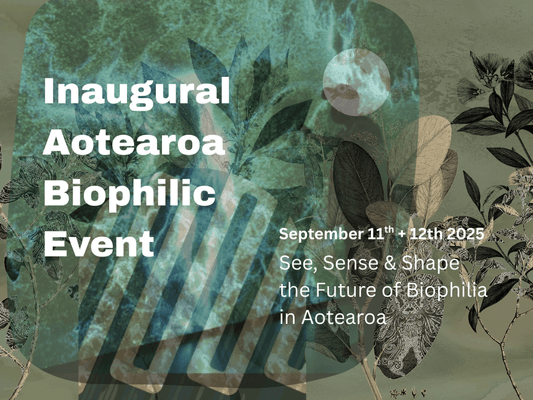
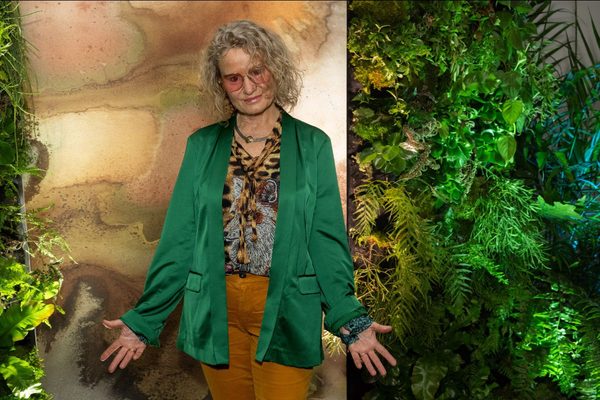
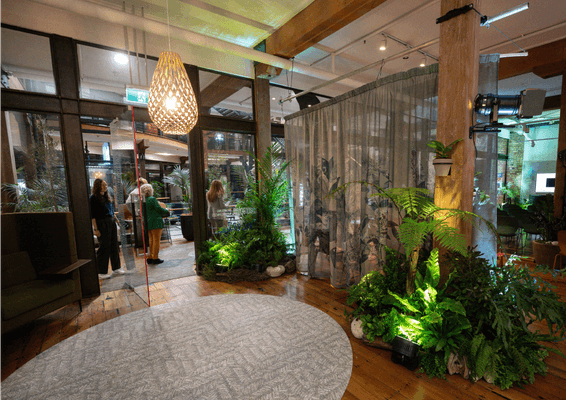
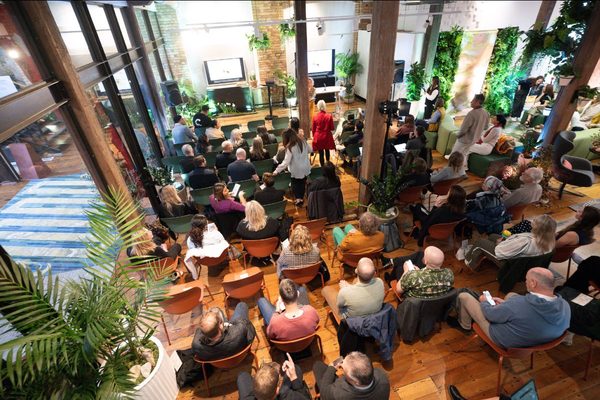
This was the question behind the inaugural Aotearoa Biophilic Event, held at our Parnell showroom last September.
Together with Miranda Brown, Tricia Love Consultants and Green Air, and with support from the New Zealand Green Building Council, we brought together designers, artists and industry experts to explore biophilic design and what a stronger connection with nature could mean for the spaces we create.
A year on, we’re revisiting the thinking behind the event, how those ideas were brought to life throughout our showroom, and what biophilic design can look like in the workplace.
At the heart of that conversation is something bigger than bringing nature indoors. Our wellbeing is closely tied to the natural world around us. Biophilic design gives us a way to think about people and planet together, and how the built environment can better support both.
Biophilic design goes further than greenery
Biophilia describes our inherent connection with nature and living systems and how that relationship can be supported within the buildings and spaces where we spend so much of our time.
And it goes well beyond putting plants around the office.
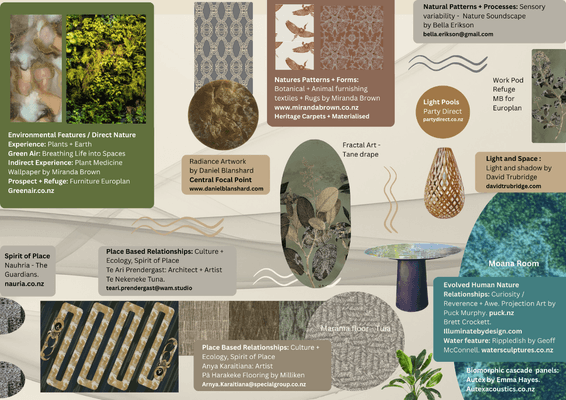
Stephen Kellert’s framework for biophilic design considers six broad elements: environmental features, natural shapes and forms, natural patterns and processes, light and space, place-based relationships, and evolved human relationships with nature.
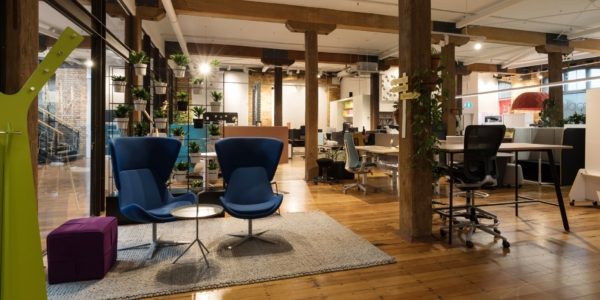
In a workplace, that can mean planting and natural light, but also water, natural materials and textures, organic forms, changing light, views, pattern and spatial variation.
It can even influence how we plan different settings. We naturally respond to both prospect, where we have outlook and can understand our surroundings, and refuge, where we feel more sheltered and secure.
Seen this way, biophilic design isn’t simply a style or aesthetic. It’s a way of thinking about the relationship between people, nature and the places we create.
That broader understanding became the foundation for the event.
Building the conversation in Aotearoa
The event wasn’t simply about showcasing what a biophilic interior could look like.
A key aim was to build knowledge around how biophilic principles can be understood and applied within New Zealand’s built environment, including helping Green Star Accredited Professionals engage with biophilic design within green building standards and certification.
Across the day, speakers and panellists approached the subject through research, business, ecology, design, art, culture, wellbeing and the built environment.
The conversation moved from the business case for biophilic design and Kellert’s framework into biophilic cities, sensory design, art for healing, cultural connection and practical application.
The ambition went beyond the event itself. It was about growing the role of biophilic design in Aotearoa, encouraging research and innovation, building a community where knowledge and better practice could be shared, and strengthening connections with the wider international biophilic design community.
Underlying those conversations was an important connection: creating environments that support people and creating a more sustainable built environment don’t need to be separate ambitions.
Biophilic design brings those conversations closer together. It asks us to consider not only how people experience the spaces we create, but our relationship with the natural systems, places and environments those spaces are part of.
Making the showroom part of the experience
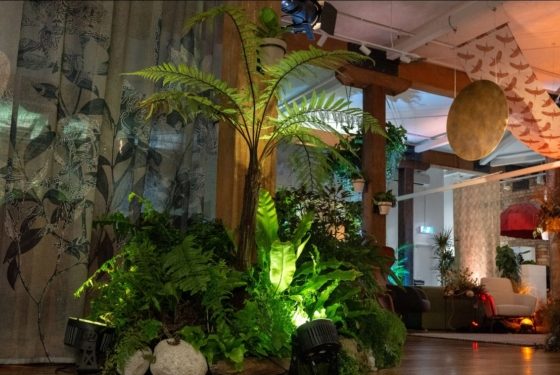
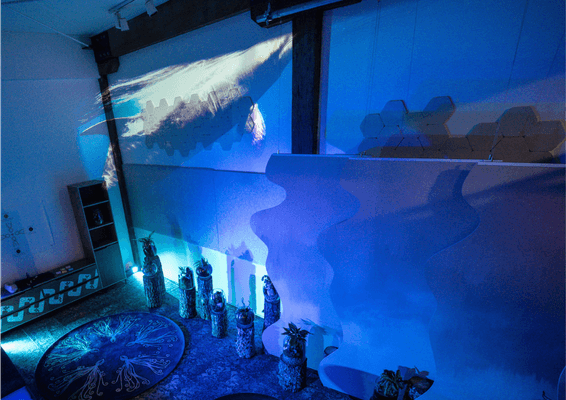
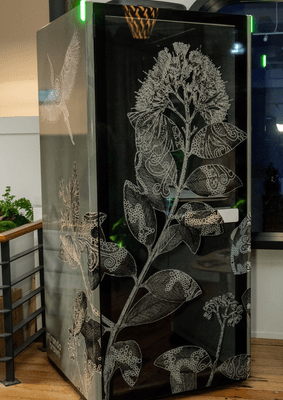
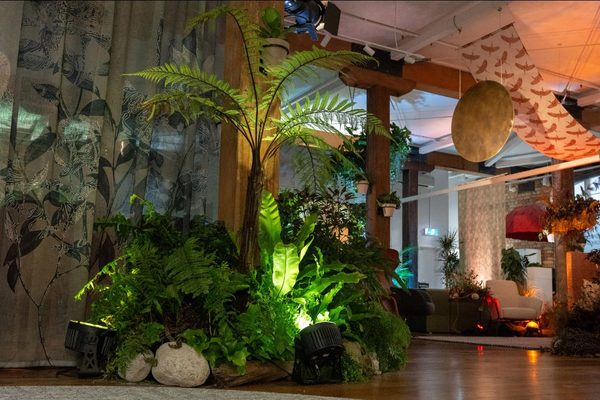
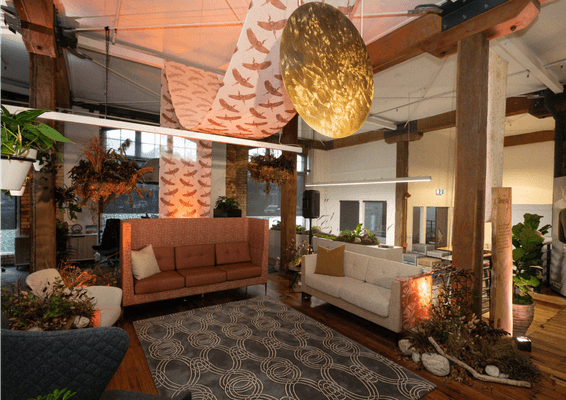
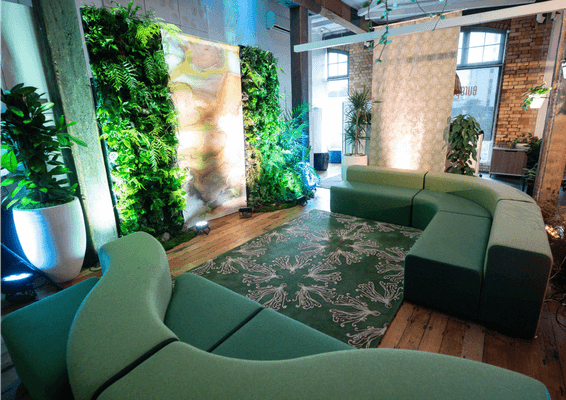
Creative Director Miranda Brown worked alongside artists, designers and businesses to transform the space through water, planting, natural fibres, art, pattern, colour, sound and story.
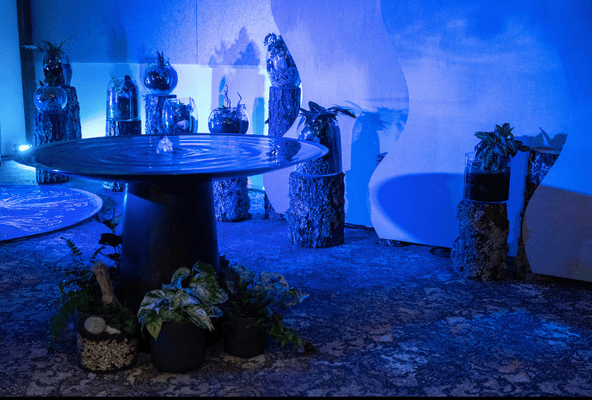
Green Air introduced sculptural gardens with native and exotic planting. In the Water Room, Geoff McConnell’s Rippledish water sculpture sat alongside water art by Brett Crockett and Puck Murphy, bringing movement and sound into the interior.
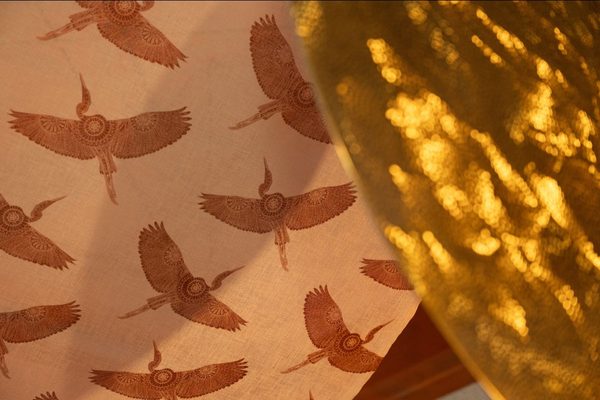
Lighting by David Trubridge, textiles and surfaces from Materialised, Heritage Carpets and Milliken Flooring, artwork by Daniel Blanshard and furniture from Europlan added further layers of material, form and texture.
The result demonstrated something that’s easy to overlook when we talk about biophilic design: nature isn’t something we experience through sight alone.
Designing for all the senses
Think about being outside.
We notice changing light, movement, sound, texture, temperature, colour, scent, scale and variation, often without consciously thinking about any of them.
That same thinking can influence an interior.
Natural materials introduce texture and variation. Water can add movement and sound. Planting can soften boundaries and change the way we move through a space. Organic forms and patterns can reference structures we recognise from nature.
Furniture and spatial planning have a role too.
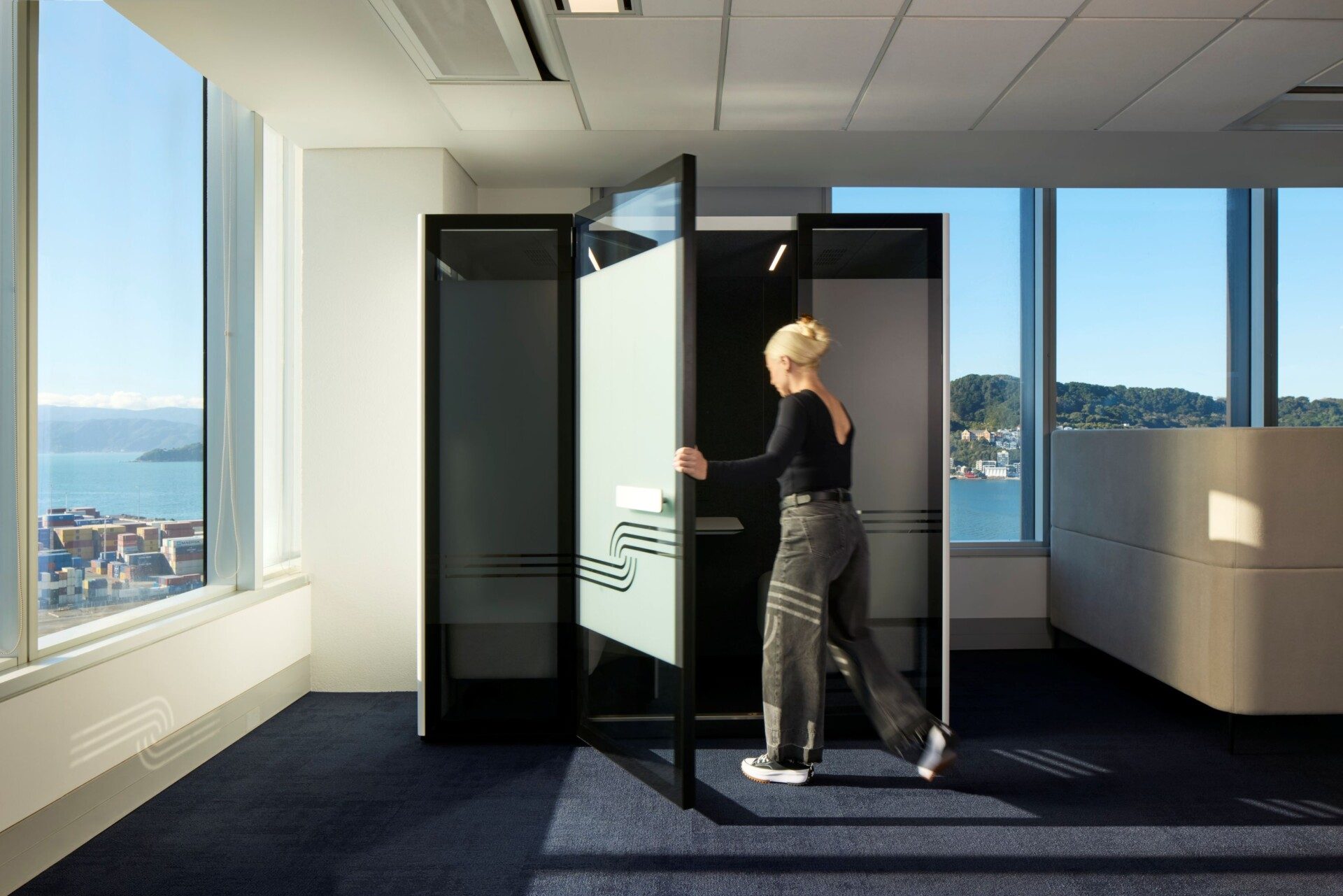
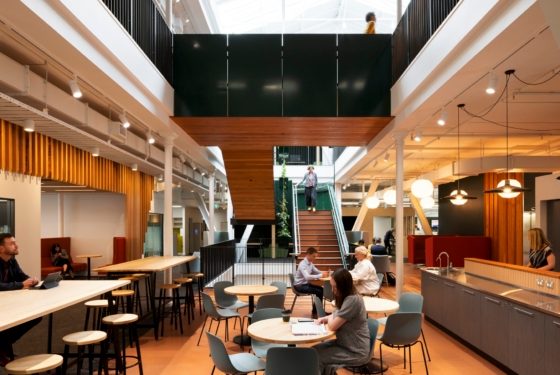
An open collaborative setting can provide outlook and connection, while a high-backed seat, booth or quieter corner can offer a sense of refuge. A well-planned workplace gives people opportunities to move between openness, privacy, interaction and retreat throughout their day.
One of the ideas reinforced by the event was that these elements work together.
Biophilic design doesn’t need to be one big gesture. Often, it’s the accumulation of thoughtful decisions that changes how a space feels and how people experience it.
Designing for place
Connection with nature is also a connection with place.
Kellert’s framework recognises relationships between people, culture, ecology and the environments they inhabit. That becomes particularly relevant when we consider what biophilic design can mean here in Aotearoa.
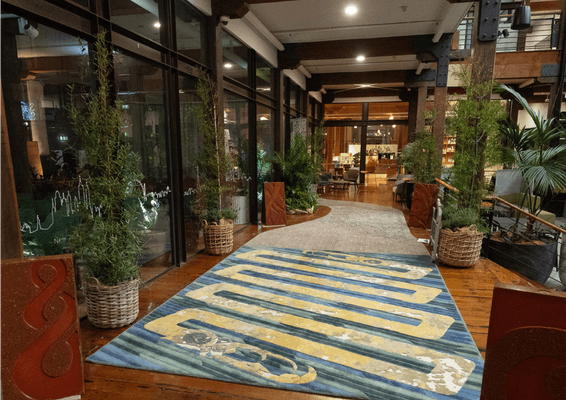
The pathway into our showroom featured Te Ari Prendergast’s Te Nekeneke Tuna, created with Heritage Carpets, telling the story of the tuna’s journey to Moana and back.
Arnya Karaitiana’s Pā Harakeke rug also featured within the interior, alongside a Tāne curtain designed by Miranda Brown and printed by Materialised.
These elements brought another dimension to the event: a reminder that designing with nature doesn’t need to look the same everywhere.
A workplace can respond to its own landscape, ecology, materials, stories and culture rather than relying on a generic idea of what “natural” should look like.
That connection to place matters. A genuinely biophilic approach isn’t simply about borrowing the appearance of nature. It’s about recognising that our buildings, workplaces and communities exist within natural and cultural systems, not separately from them.
What could this look like in your workplace?
This is where the thinking becomes practical.
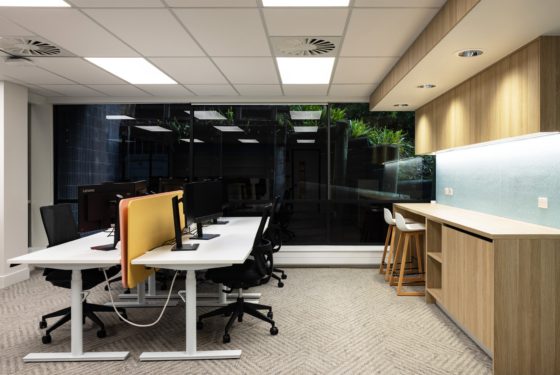
It might mean positioning workpoints to make better use of natural light and outside views, rather than automatically lining every desk up the same way.
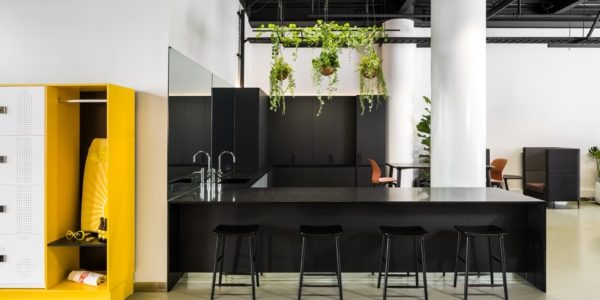
Planting can do more than decorate a room. It can soften boundaries, help define different work settings and bring variation to an otherwise hard interior.
High-backed seating, booths and quieter corners can create places of refuge alongside more open collaborative spaces. Timber, wool and other natural textures can introduce warmth and tactility. Artwork, colour and pattern can reference nature or tell something meaningful about the place a workplace belongs to.
Sometimes the best starting point is simply to look at the space differently.
Where does the morning light fall? What can someone see when they look up from their screen? Is there somewhere to retreat from a busy open area? What materials are people touching every day? Could planting help shape the space rather than simply decorate it? Does the workplace have any connection to the environment outside its walls?
And beyond how the space feels, what are those decisions asking of the environment? Where have materials come from? Can furniture adapt as needs change? Can existing elements be retained or reused? Are we designing something with longevity rather than for a moment in time?
These aren’t exclusively biophilic design questions, but they’re part of the same bigger conversation. If we’re thinking more carefully about our relationship with the natural world, it makes sense to consider both what we bring into a space and the impact of creating it.
There isn’t one formula for a biophilic workplace.
The opportunity is to use nature, material, light, pattern, space and place in ways that make sense for the people and environment you’re designing for.
Why does it matter?
These ideas aren’t only about creating workplaces that look good.
The global Human Spaces study of 7,600 office workers across 16 countries found that people working in environments with natural elements reported 15% higher wellbeing, higher productivity and 15% higher creativity than those without the same connection to nature.
The study also found that a third of respondents said workplace design would affect their decision about whether to work for an organisation.
The case for bringing nature into the workplace, then, isn’t simply aesthetic. It’s part of a wider conversation about how the physical environment can contribute to the experience and wellbeing of the people using it every day.
And that doesn’t mean every workplace needs a water feature or a wall of plants.
For one project, the opportunity might be better access to daylight and views. For another, it could be planting, natural materials, quieter spaces or a stronger connection to local landscape and culture.
What matters is that these decisions are considered intentionally, as part of creating workplaces that support people while being more conscious of their relationship with the natural world.
A year on
The inaugural Aotearoa Biophilic Design Event brought a lot of different people, disciplines and ideas into our showroom.
Nearly a year later, what has stayed with us is the connection between them.
Our wellbeing is tied to the natural world around us. The spaces we create influence that relationship, which gives the built environment an important role in supporting both people and planet.
For Europlan, that adds another layer to the questions we’re already asking when we design and furnish workplaces. How will people use this space? What do they need from it? How can the environment better support them? What impact will the choices we make have over time?
And where could nature play a bigger role?
Biophilic design doesn’t provide one answer. But it gives us a valuable way to think about light and material, openness and refuge, pattern and movement, culture and place, wellbeing and sustainability as connected parts of the same conversation.
That’s the thinking we’ve carried forward from the event, and the conversation we’re interested in continuing.
Thank you to Miranda Brown, Tricia Love Consultants, Green Air, Heritage Carpets, Te Ari Prendergast, Milliken Flooring, Arnya Karaitiana, Nauhria Guardians, Geoff McConnell, Brett Crockett, Puck Murphy, David Trubridge, Materialised, Daniel Blanshard, Wendy Douglas, Wilhemeena Monroe, and everyone who shared their knowledge, work and perspective with us.
And of course a special thank you to our sponsors! Our Premium Sponsor: Nauhria Group.
STACK Interiors, Milliken & Company, ANZ, Autex Acoustics New Zealand, New Zealand Green Building Council (NZGBC)
Want to explore what these ideas could look like in your workplace? Talk to the Europlan team about creating a workplace that better connects people, place and nature.